Biodiversity is the variety of life forms on Earth, from forests and rivers to insects, soils, and oceans. It may sound like a topic only for scientists and environmental groups, but biodiversity is deeply connected to our economy and daily lives. Nowadays, biodiversity is moving from the margins of sustainability discussions into the core of business and financial strategy as it can be considered a source of both risk and value creation. Biodiversity loss is not only an environmental problem, but also a substantial financial issue. In fact, many businesses and financial institutions depend on nature more than they realise. For companies, banks, investors, and insurers, nature underpins economic activity, asset values, and long term financial performance.
Critical Dependencies
Companies depend on biodiversity for raw materials, climate regulation, and resilience against disasters. More than $150 trillion in annual value stems from services like food production and carbon storage. EU regulations under the Kunming-Montreal framework increasingly mandate disclosures, tying business viability to nature’s health.
Many business activities depend directly on healthy ecosystems.
- Agriculture relies on fertile soil, water, and pollination.
- Manufacturing depends on stable supplies of raw materials.
- Construction and real estate are affected by land use, water availability, and climate resilience.
- When biodiversity is degraded, supply chains become unstable, costs rise, and operational risks increase.
A widely cited global estimate shows that over half of the world’s economic output depends on nature to some degree. This means that biodiversity loss can directly affect company revenues and asset values. For instance, declining fish stocks threaten food and retail companies. Water scarcity disrupts production in sectors such as energy, textiles, and semiconductors. Soil degradation reduces agricultural yields and increases input costs.
Managing Risks
For the financial sector, these impacts translate into financial risk. Banks face higher credit risk when borrowers are exposed to nature related disruptions. Investors may see declining portfolio value when companies fail to manage their dependence on ecosystems. Insurers face rising claims linked to floods, droughts, and ecosystem collapse, events that are often intensified by biodiversity loss.
These risks can be categorized into transition risks, arising from efforts to shift toward more sustainable practices, and physical risks, which stem from the direct consequences of environmental degradation.
Regulatory uncertainty and social inequities increase biodiversity risks, with SMEs facing amplified value-chain pressures. Supply disruptions, greenwashing penalties, and reputational damage pose serious threats to non-compliant businesses.
Mitigation starts with risk assessments, nature-aligned investments, and policy advocacy for consistent signals. Proactive action safeguards long-term viability amid planetary boundary breaches.
Emerging Opportunities
At the same time, biodiversity creates clear financial opportunities. Private investment in nature-based solutions offers competitive edges, from blended finance to biodiversity credits. Sustainable land use, regenerative agriculture, ecosystem restoration, and green infrastructure can reduce long term costs and improve asset resilience. Studies suggest that business models aligned with nature protection could generate trillions of euros in economic value globally over the coming decade.
Companies that actively manage biodiversity related issues can strengthen their financial performance. Improved resource efficiency reduces input costs. Firms adopting TNFD frameworks can attract investors shifting toward nature-positive strategies, fostering innovation in sustainable supply chains. Cross-sector collaborations unlock scalable restoration, turning compliance into growth. Strong biodiversity governance enhances reputation and access to finance, particularly as sustainability linked loans and investment products expand.
For decision makers, biodiversity can be integrated into strategy through four financially relevant dimensions:
- Impacts, how business activities affect ecosystems and natural capital
- Dependencies, the extent to which revenues and operations rely on ecosystem services
- Risks, financial exposure linked to ecosystem degradation, regulation, and market shifts
- Opportunities, new revenue streams, investments, and cost savings linked to nature positive solutions
The financial sector plays a critical role in this transition. By pricing biodiversity risks, redirecting capital, and supporting companies that invest in nature, financial institutions can help reduce systemic risk while unlocking long term value.
How we contribute
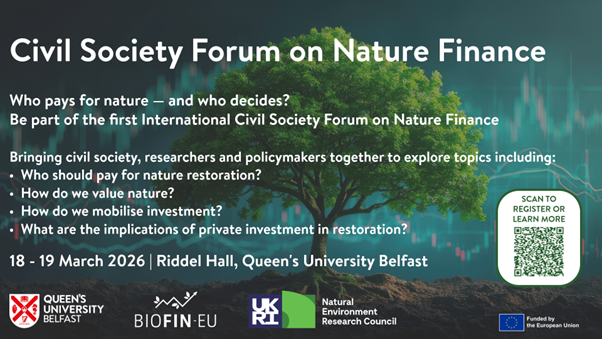
The BIOFIN-EU project supports businesses and financial institutions in navigating large scale financing challenges and develop, replicate, and scale up investments in nature based solutions, contributing to a more sustainable, resilient, and vibrant economy. By providing guidance, tools, and frameworks, BIOFIN-EU helps the private sector integrate biodiversity into financial decision making, creating enabling market conditions that maximise success and reduce barriers to implementing, governing, integrating, and expanding such investments.