The following interview took place in October at Synergy Days 2025 in Rotterdam and captures a dialogue between Ourania Ntinou and John Garvey from the University of Limerick, the Coordinator of the BIOFIN-EU.
Read on to discover how BIOFIN-EU connects ecology and finance to protect biodiversity, with a particular focus on the innovative Nature-based Solutions (NbS) Dashboard. The discussion highlights how agricultural lending can become nature-positive, supporting farmers through sustainable finance while providing banks with transparent tools for reporting and disclosure. By addressing biodiversity alongside climate goals, BIOFIN-EU is paving the way for more resilient ecosystems and sustainable financial systems.
Could you tell us a bit more about the Biofin EU project?
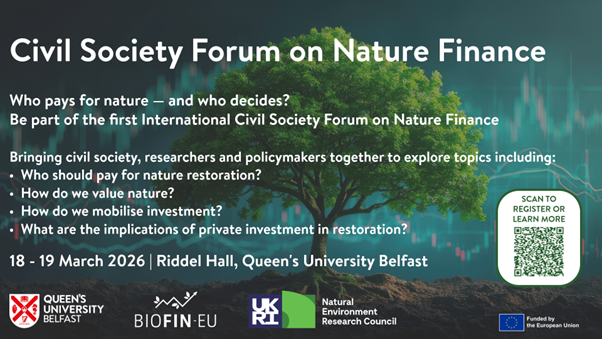
Biofin is a three-year European funded project and really we’re focused on trying to integrate expertise from ecology and finance and better understand how financial institutions can make decisions that protect and restore biodiversity and ecosystems.
I know that we’re developing a dashboard, a NbS dashboard. Could you tell us a bit more about it?
So, we conceptualised this idea of a dashboard in the original proposal and since we started the project, we’ve worked with financial institutions to really understand how they make decisions and what the barriers for them are in terms of biodiversity data, ecosystem data and so on. And now, at this stage of development, we have a prototype dashboard that we’re deploying in very specific scenarios and one of those is in bank lending.
So, when you apply to get a loan from a bank, usually the process is very streamlined, you know, you submit a certain number of documents and hopefully the bank approves your loan application. And what we’re looking at is how a dashboard can be used in agriculture lending. So, when a farmer wants working capital or they want to invest and develop infrastructure on their farm, we want to help the bank understand the impact of that loan on the local ecosystems that the farm is working with and then have a mechanism to nudge the farmer towards taking nature-positive action on that farm.
So, the dashboard really is a tool that’s designed to be integrated into the loan approval process and support banks then in terms of their reporting and disclosure requirements both to regulatory authorities and to their counterparties in the financial system.
So we see that this dashboard can benefit a lot of people, right? Who are the main users you’re targeting?
Yeah, so there’s a knowledge gap and I suppose an expertise gap on both sides of the loan transaction. So, the farmers don’t know how to take action at a ground level to better protect ecosystems and also the banks don’t know the right set of questions to ask. So, part of what our dashboard is doing is introducing a third party in, an expert, an ecological expert who can make an assessment on the farm, provide guidance and for that guidance then to feed into the loan approval process. So, we see this as benefiting farmers, giving them access to finance but access to finance in a way that guarantees that the funds are going to be used to protect local ecosystems that will make food production more resilient in the future, help farmers to adopt their mode of production so it’s more sustainable.
That’s a really important component of what we’re doing and then also for banks, it gives them a much more transparent mechanism to link. So, the loan identification and then feed that information through to funders. So, in other parts of the financial system that are providing the capital for that loan, they can see that this loan is actually sustainable and is having a positive impact.
Okay, we see a lot of potential here, right?
I think, yeah, I think it’s really challenging. Like, we’re very optimistic about what we’re doing, we’re working very closely with both the farmer community, with people that work with farmers and with banks. It’s very difficult to adopt this new technology.
In terms of sustainable finance, this objective around biodiversity and ecosystems is one that’s being left to one side while the focus has been on climate emissions. We do see its importance, we do recognise the challenges in terms of adopting this technology, but we feel that our approach gives us the best chance to having this adopted in the near term.
The full interview is also available on our YouTube channel.